In 1948, Harada began studying economics and commerce atWaseda University At the university, he trained under both Funakoshi (on Saturdays) and Toshio Kamata (Watanabe), and befriended Tsutomu Ohshima. In 1949, the Japan Karate Association (JKA) was formed; Harada would often escort Funakoshi by taxi around this time. He also came into contact with Shigeru Egami (also studying commerce at the time) and Tadao Okuyama, then ranked 3rd dan, at Waseda.
Harada trained under both men, and they had a significant influence on his karate style. Harada completed his Bachelor of Commerce degree in 1953 and went on to complete a master's degree in 1955. During postgraduate studies, he assisted Masatoshi Nakayama in teaching karate to the US military.
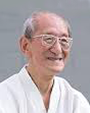
Following completion of his tertiary studies, Harada took a position with the Bank of South America in São Paulo, Brazil. His manager there, on learning of his new employee's martial art training, asked him to conduct a demonstration; following this, fellow employees and other associates began training under his direction. Initially, the karate training took place in a judo dojo. Harada wrote to Funakoshi to request affiliation with the JKA, but the latter apparently wrote back advising him to start his own karate organisation. This marked the birth of Karate-do Shotokan Brazileo.
In 1956, Funakoshi awarded Harada the rank of 5th dan, which was then the highest rank in Shotokan karate. He has kept the same rank to this day, and 5th dan is still the highest rank attainable in his organisation (the KDS). In April 1957, Egami sent Harada a telegram to inform him that Funakoshi had died. In the period that followed, political troubles saw many of Funakoshi's senior students (including Harada) form the Shotokai group separate from the JKA.
By 1963, Harada had around 16 students holding black belt status at his dojo. At the time, karate students in Paris had heard of him and had saved enough money to buy him an airline ticket to their city; Harada resigned from the bank, intending to take a year to travel before returning to Brazil. After teaching in France, he travelled to the United Kingdom at the invitation of Kenshiro Abbe. In early November 1963, he taught a karate course at Abbe's dojo. On 23 November 1963, Harada demonstrated karate as part of the National Judo Championships being held in London.
Through the mid-1960s, Harada taught karate in the UK and Brussels and founded the KDS in 1965. Harada returned to Japan for six months in 1967 and, while he apparently did not consider the journey fruitful overall, he did confirm a replacement to lead his dojo in Brazil: Arinobu Ishibata. Harada was based in the UK for the rest of his life. The KDS experienced significant divisions in 1971 and 1988.
In October 1998, the Nihon Karate-do Shotokai invited Harada back to Tokyo to demonstrate his art as part of Shotokan karate's 60th anniversary celebration, and he and a selection of his top students did so.
In 2007, Queen Elizabeth II appointed Harada as a Member of the Order of the British Empire for his services to karate. Martial arts author Clive Layton has written two biographical works on Harada: Karate Master: The life and times of Mitsusuke Harada (1997) and Reminiscences by Master Mitsusuke Harada (1999, co-authored with Harada).
Mitsusuke Harada died on 26 February 2021 at his home in Cwmbran at the age of 92.